Royal Falcon Hunt Attack
The Deer KingThe Royal Falcon Hunt Attack is the sudden assault by black, wolflike beasts on falconers and guests at a royal hunt, transforming a field ceremony into a deadly melee. The attack leaves members of both Aquafaese and Zolian society bitten, including the royal family’s Mazai and the governor’s family members Utalu and Olimu; the resulting cases become central to Hohsalle’s investigation of the disease and its uncertain means of spread.
Causes and Setting
The attack erupts at a falcon hunt attended by the King of Aquafa, the Zolian governor and their households. Its political contrasts are already visible in the gathering: Yotalu stands with the Aquafaese royal family, while his older brother Utalu wears the blue headband of the Zolian team. Mazai’s son Olimu and Yotalu’s son are positioned together with their uncle, a falconer, to learn from him. The event thus brings members of the conquered country and the ruling power into a shared public space, with family ties crossing that political divide.
As the hounds bay, falconers turn toward the direction they expect the prey to emerge. Shrubs rustle behind them, and black shapes race out across the field. At first, Makokan and the watching guests mistake the beasts for hounds returning from the hunt. The spectators’ uncertainty delays recognition: alarm comes only when the animals charge directly at the falconers.
The Assault
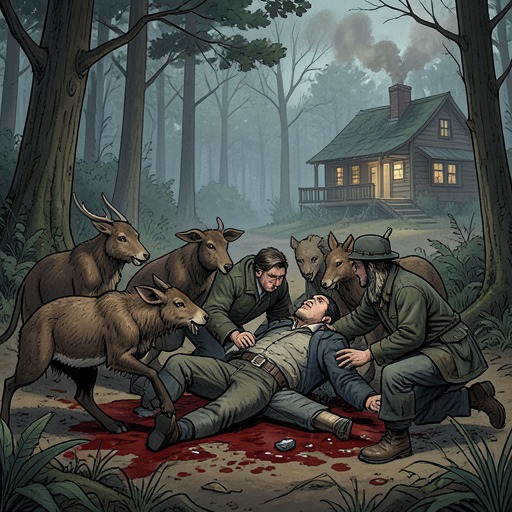
The black beasts leap upon the falconers as they turn to shield their hawks. Their bared fangs and streaming saliva mark them as more than ordinary hunting dogs. One falconer is knocked down while raising an arm to protect his throat, and the falcon on the nearest Zolian’s fist screeches and takes flight. The scene’s familiar order—the falconers facing the anticipated quarry—has become an attack from an unexpected direction.
A beast charges Utalu, but the veteran soldier responds without hesitation: he releases his falcon, draws his hunting knife, and faces the attacker. Mazai pushes the boys behind him; the pack surrounds them and briefly hides them from view. Across the meadow, shouting men and snarling animals replace the quiet of the autumn hunt. The King calls for his nephew, Yotalu for his son, and Sulumina cries Olimu’s name.
The danger expands beyond the falconers and boys. The King and his guests rise, but guards hold them inside the pavilion. Aquafaese and Zolian soldiers run to help, then falter when still more beasts burst from the underbrush and rush toward the pavilion. Yotalu orders the soldiers to aid Olimu while the people at the pavilion hold their position; the King, in turn, urges them toward Mazai. The attackers have turned the hunt’s competing calls and commands into an urgent struggle to reach the endangered men and boys.
Victims and Immediate Aftermath
When the immediate disturbance ends, the King and Governor Ohan recover their composure and direct their soldiers to assess the damage. The King asks Hohsalle to leave the washing of minor wounds to others and check those outside, and Hohsalle hurries from the pavilion. The attack’s victims include Mazai, his son Izam, Utalu and Olimu. These named injuries connect the violence directly to both the Aquafaese royal family and the Zolian governing household, making the consequences more than a threat to unidentified hunters.
The morning after the attack, Hohsalle visits the governor’s palace to examine Utalu, one of the wounded. He has to visit all the victims and has managed only a quick breakfast before setting out from the clinic. Governor Ohan is expecting him; servants lead the physician deep into the palace, where Lona is already taking Utalu’s pulse. The visit begins the transition from an assault in the open field to the close observation of individual patients.
From Attack to Epidemic Investigation
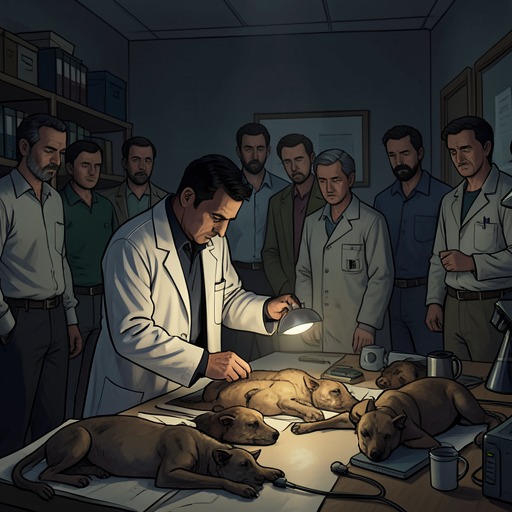
The falcon hunt becomes a crucial reference point in Hohsalle’s effort to understand the illness affecting the bitten. He later gives a detailed account of how the disease appeared and progressed among those attacked at the hunt. His observations sit alongside the earlier salt-mine disaster, where victims developed symptoms rapidly and died in overwhelming numbers. Because no workers at the mine had shown signs of illness since that incident, Hohsalle argues that ordinary person-to-person spread, fleas or ticks, and transmission through the air do not adequately explain the pattern; bites from an infected beast appear more plausible. Yet he cautions against indiscriminately hunting wild dogs or wolves: shepherds were not reported to have fallen ill after attacks on sheep, suggesting that only particular animals might carry the infection.
The cases at the hunt also reveal unequal susceptibility. The Zolian falconer bitten near the chin develops the most severe symptoms most quickly, while Sulumina shows the greatest resistance, followed by Mazai and Olimu. Hohsalle regards the difference as a question for investigation, not proof of the politically charged Curse of Aquafa. Identifying why some people resist the disease could help establish prevention, but he recognizes that surveying all of Aquafa—including remote regions and nomadic clans—would be a formidable task.
Later, a map assembled from reports shows that mittsual-like illnesses had appeared across the former Kingdom of Aquafa before either the salt-mine disaster or the hunt. Cases extend from the Yukata Plains in the south to the Oki forests in the north, and the oldest reported case dates back eight years. The accounts describe isolated wolf or ossam attacks, usually with only one or two people contracting the illness and no reported spread. Hohsalle finds this distribution difficult to reconcile with a disease carried by animals that live in packs: if one wolf’s bite infected people, further cases might be expected within the same pack’s territory, while years of tick and mosquito breeding should have widened the outbreak if those insects were transmitting it. The scattered records turn the hunt from an isolated catastrophe into one visible point in a longer, still-unexplained history of disease.
Significance
The attack’s force lies in the reversal of an organized hunt. The participants wait for prey to emerge in a predictable direction; instead, the black beasts rush from behind the falconers and then multiply into a threat that also reaches the pavilion. The initial mistake—taking the attackers for returning hounds—shows how quickly a familiar animal spectacle can become deadly when its signs are misread.
The assault also gives the disease investigation a concentrated group of victims whose symptoms can be compared, while the later map complicates any assumption that the crisis began with the hunt. The event is both a public rupture and a medical puzzle: its victims make the danger immediate, but the widely separated earlier reports leave the underlying pattern unresolved.